NASA ISS Spacewalk June 30: Two Astronauts to Spend Nearly 7 Hours Outside the Space Station
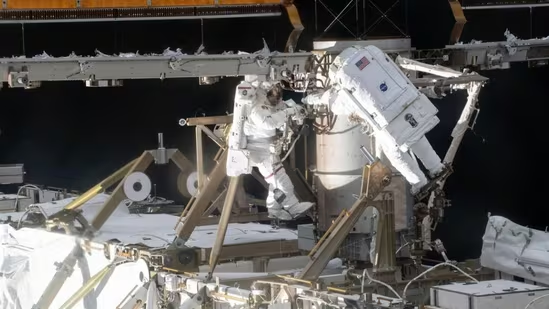
The NASA ISS Spacewalk June 30 mission is set to be one of the agency’s most significant maintenance operations of the year. NASA astronauts Jessica Meir and Chris Williams will step outside the International Space Station (ISS) on June 30 for a spacewalk expected to last nearly seven hours.
The primary objective of the extravehicular activity (EVA) is to replace a faulty wrist joint on Canadarm2, the station’s iconic robotic arm that has supported ISS operations for more than two decades. NASA has scheduled the spacewalk to begin at approximately 8:35 a.m. EDT (6:05 p.m. IST).
This will be another major milestone in Expedition 74’s mission as astronauts continue maintaining the orbiting laboratory roughly 400 kilometers above Earth.
Who Are the Astronauts?
The spacewalk will be carried out by two experienced NASA astronauts:
Jessica Meir
Jessica Meir has previously completed multiple spacewalks and is well known for her work aboard the ISS. She has extensive experience conducting scientific research and performing complex maintenance tasks in space.
Chris Williams
Chris Williams is part of NASA’s Expedition 74 crew and has already participated in previous ISS spacewalks. His experience with external station maintenance makes him well prepared for the upcoming repair mission.
Together, the astronauts will carefully replace the damaged component while operating in the challenging environment of space.
Why Is the Spacewalk Necessary?
The mission became necessary after engineers detected a malfunction in one of Canadarm2’s wrist joints during routine operations in May 2026.
NASA reported that the joint began drawing unusually high electrical current and eventually stopped responding to commands. To avoid additional damage, mission controllers parked the robotic arm in a safe position until astronauts could replace the faulty component.
Replacing the wrist joint will restore the robotic arm’s full operational capability.
What Is Canadarm2?
Canadarm2 is one of the most important robotic systems aboard the International Space Station.
Installed in 2001, the 17.6-meter-long robotic arm performs numerous critical tasks, including:
- Capturing visiting cargo spacecraft.
- Assisting astronauts during spacewalks.
- Moving large equipment around the station.
- Supporting maintenance and repair activities.
- Inspecting external ISS components.
Over the past 25 years, Canadarm2 has played a central role in building and maintaining the ISS, making it an indispensable part of station operations.
Mission Timeline and Duration
NASA expects the EVA to last approximately 6.5 to 7 hours, depending on operational conditions.
The planned activities include:
Removing the Faulty Joint
Astronauts will detach the malfunctioning wrist joint from Canadarm2.
Installing the Replacement
A replacement joint already stored aboard the ISS will be installed in its place.
Functional Testing
Once installed, astronauts and mission controllers will verify that the robotic arm operates normally.
Additional Maintenance (If Time Permits)
If the primary repair is completed ahead of schedule, the crew may perform additional maintenance tasks outside the station.
Why This Repair Is Important
The success of the NASA ISS Spacewalk June 30 mission is critical because Canadarm2 supports many essential ISS operations.
A fully operational robotic arm is needed for:
- Future cargo spacecraft arrivals.
- Space station maintenance.
- Scientific experiments.
- External equipment installation.
- Support during future astronaut spacewalks.
Without Canadarm2, many maintenance activities would become significantly more complex and time-consuming.
NASA engineers have spent weeks preparing both the astronauts and ground teams to ensure the repair proceeds safely and efficiently.
How to Watch the Spacewalk Live
NASA will provide live coverage of the spacewalk through NASA+, the agency’s streaming platform, and its official television channels.
Coverage will begin before the astronauts exit the Quest airlock and will include:
- Mission briefings.
- Real-time astronaut communications.
- Live camera views from the ISS.
- Commentary from NASA mission control.
Viewers around the world will be able to follow the operation as it unfolds in real time.
Also read: Ecuador World Cup Knockout Spot Secured After Stunning Victory Over Germany