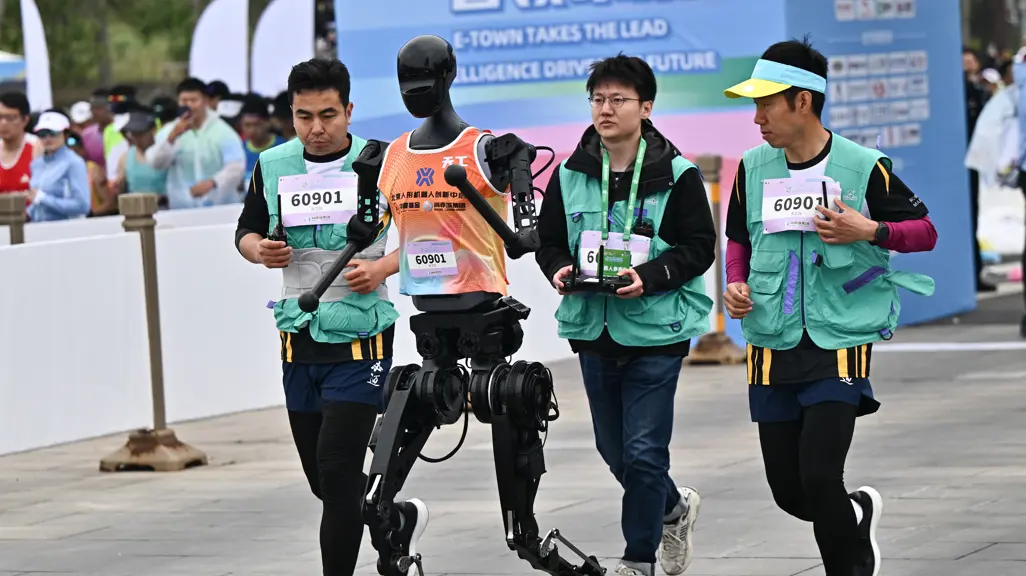
Beijing’s robot half-marathon pushes machines to the limit as humanoids undergo punishing race training
Humanoid Robots Face Intense Training Ahead of Beijing’s Historic Half-Marathon
China is preparing for one of the most unusual sporting-tech events of 2026 as Beijing gets ready to host a humanoid robot half-marathon, where machines will run alongside human participants over a full 21.1-kilometre course. But while the event sounds futuristic and entertaining, reports suggest the preparation process for these robots has been anything but easy. Engineers say training the machines for endurance, balance, and decision-making has become a gruelling challenge.
The upcoming race, scheduled in Beijing’s Yizhuang technology district, is expected to attract more than 300 robots—far higher than last year’s smaller competition that saw only 21 bots participate.
A Marathon Unlike Any Other
Unlike traditional races, this half-marathon will not simply measure speed. Organisers are reportedly assessing multiple performance factors, including:
- Running stability
- Energy efficiency
- Real-time navigation
- Obstacle handling
- Autonomous decision-making
- Endurance over long distance
- Natural gait and movement quality
This means robots must behave less like remote-controlled gadgets and more like independent athletes.
Why Training Is So Difficult
Running for humans is instinctive. For robots, it is one of the hardest movement problems in engineering.
Every step requires sensors, motors, software calculations, and balance adjustments. A tiny miscalculation can cause a fall.
Engineers involved in training say robots must repeatedly practice:
- Turning corners
- Maintaining pace
- Handling uneven surfaces
- Recovering balance after slips
- Avoiding collisions
- Preserving battery life
Even minor overheating or battery drain can ruin a full race attempt.
Night Practice Sessions on Empty Streets
According to reports, several robotics teams in Beijing have been conducting late-night training runs on empty roads in Yizhuang.
The nighttime practice allows engineers to simulate real race conditions while reducing public disruption. During these sessions, teams monitor movement patterns, joint stress, speed control, and battery consumption.
This behind-the-scenes preparation resembles elite athlete training camps—except the runners are made of metal and circuits.
Last Year’s Lessons: Many Robots Failed
The urgency of this year’s preparation comes after last year’s event exposed major limitations.
Only six out of 21 participating robots reportedly completed the earlier race. Others suffered falls, overheating, technical shutdowns, or mobility failures.
That outcome made clear that long-distance robotic movement remains one of the toughest frontiers in AI hardware.
Tiangong Ultra Sets the Benchmark
The winner of last year’s race was Tiangong Ultra, a tall lightweight humanoid robot that completed the course in approximately 2 hours and 40 minutes.
Now rival teams are trying to beat that benchmark while improving autonomy and reliability.
The challenge is not only to finish—but to finish without constant human intervention.
Autonomous vs Human-Controlled Robots
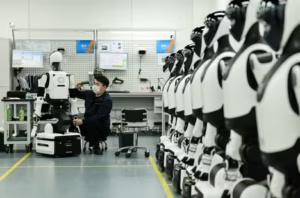
Reports indicate around 40% of this year’s entrants are expected to operate autonomously, while others may still rely partly on human steering or remote support.
That creates an interesting competition between two development philosophies:
Fully Autonomous Robots:
- Greater innovation value
- Stronger AI capability
- More difficult engineering challenge
Assisted Robots:
- Higher completion chances
- Better safety control
- Useful transitional technology
Observers say autonomous finishers will likely receive the most attention.
China’s Bigger Robotics Ambition
The marathon is more than a publicity stunt. It reflects China’s growing push to become a global leader in humanoid robotics.
Reports say China now has over 150 humanoid robot manufacturers, along with university and government research teams working in the sector.
By hosting public competitions, officials can:
- Showcase innovation
- Attract investors
- Test practical hardware
- Encourage competition
- Speed up commercialization
This strategy mirrors how self-driving car contests helped boost autonomous vehicle development years ago.
What Winning Could Mean
This year’s champion is expected to receive guaranteed orders worth more than one million yuan, according to reports.
That makes the event commercially significant. A strong performance could help startups secure:
- Government contracts
- Private investment
- Media attention
- Industrial partnerships
- Future manufacturing deals
For many teams, the race is as much about business as technology.
Experts Say Endurance Is the Real Test
While flashy demonstrations often focus on robots dancing or performing stunts, experts say endurance movement is a more serious benchmark.
A robot that can continuously run for 21 km demonstrates:
- Efficient motor systems
- Reliable battery management
- Durable hardware joints
- Strong balance control
- Advanced movement AI
These capabilities could later apply to logistics, rescue operations, patrol duties, and factory assistance.
Public Fascination Growing
Videos of humanoid robots training for the event have already spread online, drawing reactions ranging from excitement to humor.
Many viewers compare the scene to science-fiction films, while others joke about robots needing coaching staff and recovery therapy.
Yet beneath the novelty lies genuine engineering progress.
What to Expect on Race Day
The April 19 event in Beijing is likely to draw global attention. Key questions include:
- How many robots will finish?
- Will any beat last year’s time?
- Can autonomous bots outperform guided ones?
- Will breakdowns still dominate headlines?
- How close are robots to everyday usefulness?
The answers may shape perceptions of humanoid robotics worldwide.