LIVE Iran Conflict Updates: Fatality Reported After US-Israeli Strikes Target Bushehr Nuclear Facility

LIVE Iran Conflict: Fatality Reported After Strikes Near Bushehr Nuclear Plant
The war in West Asia has entered a dangerous new phase, with reports confirming that a US-Israeli strike near Iran’s Bushehr nuclear power plant killed one guard and damaged a support building. While Iranian officials insist the reactor itself remains intact and no radiation has leaked, the incident underscores the escalating risks of the conflict and its potential to destabilize not only the region but also global energy markets.
The Bushehr Strike
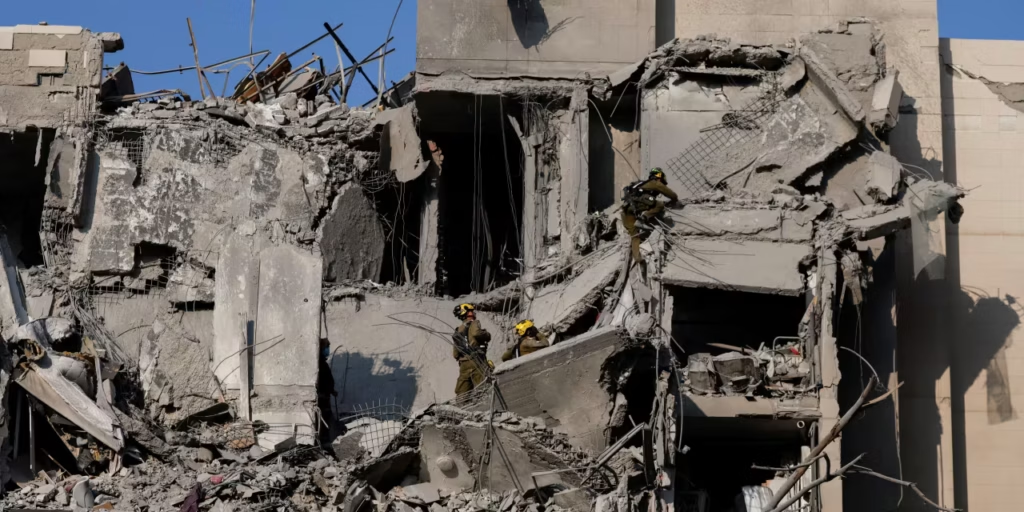
On April 4, 2026, Iranian state media reported that a projectile struck near the Bushehr nuclear facility in southern Iran. The attack killed one guard and damaged a non-critical support building. Iran’s Atomic Energy Organization quickly moved to reassure the public and international observers that the reactor core was unaffected, and there was no danger of radiation release. Still, the symbolism of striking near a nuclear site is profound: it signals a willingness by US and Israeli forces to target infrastructure that Tehran considers central to its sovereignty and technological progress.
The Bushehr plant, built with Russian assistance and operational since 2011, has long been a point of contention in international diplomacy. While Iran insists it is used for civilian energy purposes, critics have argued that it could serve as a cover for military ambitions. The strike therefore carries both military and political weight, raising questions about whether nuclear facilities could become deliberate targets in the ongoing war.
Wider Strikes in Khuzestan
The Bushehr incident was not isolated. On the same day, explosions rocked the Mahshahr Petrochemical Zone in Khuzestan Province, injuring at least five people. Three companies operating in the zone were hit, and authorities warned of “high chances of casualties” as damage assessments continued. Khuzestan, rich in oil and petrochemical infrastructure, has become a focal point of the conflict, with strikes there threatening to disrupt Iran’s energy exports and further destabilize global supply chains.
Regional Fallout
The conflict’s ripple effects are already being felt across neighboring states. Iraq closed the Shalamcheh border crossing after an Iraqi traveler was killed in nearby strikes. This closure not only hampers trade but also signals Baghdad’s growing alarm at being drawn into the conflict. Meanwhile, Israel claimed responsibility for strikes on military sites in Tehran, including facilities linked to the Islamic Revolutionary Guard Corps (IRGC). Iran responded by shooting down two US jets and one drone over Isfahan, marking the first time in over two decades that US aircraft have been lost to enemy fire.

These developments highlight the war’s rapid escalation. What began as targeted strikes has evolved into a multi-front conflict involving nuclear sites, petrochemical zones, and cross-border casualties. The risk of miscalculation is high, and the potential for the conflict to spill into neighboring countries is increasing.
Global Energy and Economic Impact
Beyond the battlefield, the war is already reshaping global energy markets. Iran has blocked much of the Strait of Hormuz, a critical chokepoint through which nearly a fifth of the world’s oil passes. This blockade, combined with strikes on petrochemical infrastructure, has sent shockwaves through global supply chains. Oil prices have surged, LNG shipments have been disrupted, and countries dependent on Middle Eastern energy are scrambling to secure alternative supplies.
The economic consequences are not limited to energy. Falling missile debris has been reported in Dubai, raising concerns about the safety of international business hubs in the Gulf. Qatar and Saudi Arabia, both heavily invested in regional stability, are watching closely as the conflict threatens to undermine their economic and security strategies.

Historical Context
The current war erupted over a month ago after US-Israeli strikes killed Iran’s former Supreme Leader Ali Khamenei. That assassination triggered widespread fighting across West Asia, drawing in multiple actors and destabilizing long-standing balances of power. The Bushehr strike represents a continuation of this trajectory, with each new attack raising the stakes and deepening the sense of crisis.
Human Cost
While much attention has focused on military and economic dimensions, the human toll is mounting. Civilians in Iran, Iraq, and neighboring states are facing increasing danger from airstrikes, missile debris, and economic disruption. The death of a single guard at Bushehr may seem minor compared to larger casualty figures, but it symbolizes the vulnerability of individuals caught in the crossfire of geopolitical struggles.

Conclusion
The strike near Iran’s Bushehr nuclear plant marks a pivotal moment in the ongoing US-Israeli conflict with Tehran. Though the reactor remains intact, the incident underscores the war’s potential to escalate into areas once considered off-limits. Coupled with strikes on petrochemical infrastructure, border closures, and the downing of US aircraft, the conflict is rapidly intensifying, with profound implications for regional stability and global energy markets.