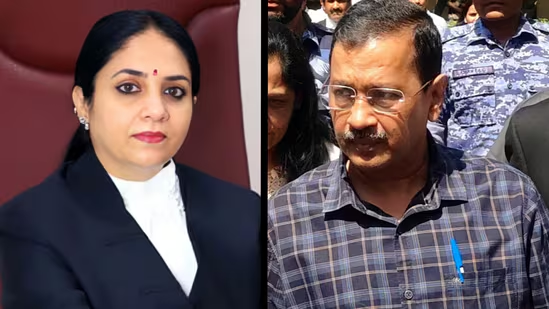
Arvind Kejriwal Refuses to Appear Before Delhi High Court, Writes Letter to Justice Sharma
A fresh legal and political controversy erupted on Monday after Aam Aadmi Party (AAP) chief Arvind Kejriwal informed the Delhi High Court that he would not appear before the bench of Justice Swarana Kanta Sharma in the ongoing excise policy case. In a strongly worded letter, Kejriwal said his “hope of getting justice has been broken”, and therefore he would neither appear personally nor send legal representation to the court.
The move comes days after Justice Sharma rejected Kejriwal’s plea seeking her recusal from hearing matters connected to the Delhi liquor policy case.
What Kejriwal Said in His Letter
According to reports, Kejriwal addressed a written communication directly to Justice Sharma, stating that after recent developments, he no longer had confidence that he would receive a fair hearing. He reportedly invoked the principle of satyagraha, saying his decision to stay away was a peaceful protest rooted in moral conviction.
The letter has quickly become the center of national debate, with supporters calling it a stand against perceived bias and critics describing it as disrespectful to judicial institutions.
Background: Recusal Plea Rejected
The controversy began when Kejriwal moved an application requesting that Justice Sharma step aside from hearing the case. The plea cited apprehensions of bias and conflict of interest. However, the judge dismissed the application in a strongly worded order, stating that judicial integrity cannot be compromised by speculative allegations or pressure from litigants.
Justice Sharma reportedly said judges cannot recuse themselves merely to satisfy unfounded suspicions.
That rejection appears to have triggered Kejriwal’s latest decision.
Excise Policy Case at the Core
The matter relates to the Delhi excise policy investigation, one of the most politically charged legal battles in recent years. While a lower court had earlier discharged Kejriwal and several co-accused, the CBI challenged that discharge order in the Delhi High Court, leading to ongoing proceedings.
The case has already seen multiple court hearings, arrests of political figures, and sharp exchanges between the AAP and BJP.
Political Reactions Intensify
The BJP was quick to attack Kejriwal’s decision, accusing him of undermining the judiciary whenever rulings do not go in his favor. Party leaders said refusal to appear before court sets a dangerous precedent.
AAP leaders, however, defended their chief, claiming he has merely expressed legitimate concerns over impartiality and is exercising democratic protest within constitutional limits.
The latest episode is likely to deepen tensions between the ruling establishment and opposition forces in the national capital.
Legal Experts Divided
Several senior legal commentators have expressed mixed views.
Some argue:
- A litigant cannot choose which judge hears a case
- Non-appearance could weaken legal standing
- Institutional respect must be preserved
Others note:
- Recusal concerns are sometimes raised legitimately
- Written protest is not automatically contempt
- Courts may still proceed based on law and procedure
The final legal consequences may depend on the High Court’s next administrative and judicial response.
What Happens Next?
The court now has several possible options:
- Proceed with the matter in Kejriwal’s absence
- Direct personal appearance or representation
- Issue notice regarding non-cooperation
- Continue hearing the CBI challenge on merits
Observers say the coming hearings could significantly impact both the excise case and the wider political narrative.
Why This Matters Politically
Kejriwal remains one of the country’s most prominent opposition leaders. Any confrontation involving him and the judiciary immediately attracts national attention.
With elections approaching in multiple states, AAP may use the controversy to claim political victimisation, while rivals will project it as defiance of institutions.