South Korean President Lee Jae-myung lands in India for key summit with PM Modi; trade, shipbuilding and AI top agenda
South Korean President Lee Jae-myung Arrives in India for Strategic Talks With PM Modi
South Korean President Lee Jae-myung has arrived in India on a three-day state visit, marking a major diplomatic moment between New Delhi and Seoul. The visit is being seen as an effort to deepen economic ties, strengthen strategic cooperation, and expand collaboration in fast-growing sectors such as shipbuilding, artificial intelligence, semiconductors, defence, and supply chain resilience. It is the first bilateral visit to India by a South Korean president in over eight years.
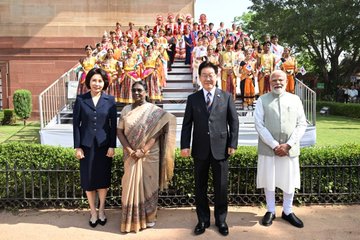
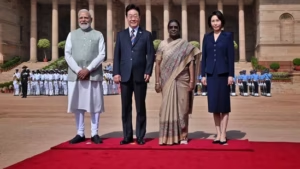
President Lee was welcomed in New Delhi with ceremonial honours and is accompanied by First Lady Kim Hea-kyung, senior ministers, officials, and business leaders. His visit includes high-level meetings with Prime Minister Narendra Modi and President Droupadi Murmu.
PM Modi-Lee Summit in Focus
The centrepiece of the visit is President Lee’s bilateral summit with Prime Minister Narendra Modi, where both sides are expected to review the India–South Korea “Special Strategic Partnership” and identify new growth sectors.
Key agenda points are expected to include:
- Trade expansion
- Shipbuilding cooperation
- Artificial intelligence partnerships
- Semiconductor supply chains
- Defence manufacturing
- Clean energy collaboration
- Maritime security
- Mobility and talent exchange
Officials from both countries believe the relationship now needs to move beyond traditional trade into next-generation strategic sectors.
Shipbuilding Set for Major Push
One of the most closely watched topics is shipbuilding cooperation.
South Korea is one of the world’s strongest shipbuilding powers, while India is trying to rapidly expand maritime manufacturing under national industrial programs. Reports suggest discussions may include joint ventures for LNG carriers, cargo vessels, port infrastructure, and technical know-how transfer.
Experts say if a major agreement emerges, it could significantly boost India’s shipbuilding ecosystem and reduce dependence on imports.
Artificial Intelligence and Tech Cooperation
Artificial intelligence is another major pillar of the visit.
India’s software strength and South Korea’s advanced hardware ecosystem make the two nations potentially complementary partners in AI development. Expected areas of discussion include:
- AI research partnerships
- Smart manufacturing
- Semiconductor-linked AI systems
- Robotics collaboration
- Cybersecurity frameworks
- Startup ecosystem partnerships
With AI becoming a strategic economic battleground globally, both nations are looking to secure a competitive position.
Trade Target May Be Raised
Bilateral trade between India and South Korea stood around $25.7 billion in 2025, and both sides are reportedly exploring a roadmap to nearly double that figure to $50 billion by 2030.
Talks may also focus on upgrading the existing Comprehensive Economic Partnership Agreement (CEPA), simplifying tariffs, improving market access, and reducing business barriers.
South Korean firms such as Samsung, Hyundai, LG, and SK Group already have a strong presence in India, while Indian companies are increasingly exploring Korea-linked manufacturing and tech opportunities.
Supply Chain Security a Priority
The timing of the visit is significant because global supply chains remain under pressure from geopolitical tensions and maritime disruptions.
President Lee reportedly highlighted that India and South Korea are becoming increasingly vital strategic partners amid international instability.
That means discussions are likely to focus on:
- Critical minerals
- Electronics components
- Energy imports
- Shipping route security
- Diversified manufacturing networks
Hormuz and Maritime Security
With recent uncertainty around the Strait of Hormuz, maritime security has become especially relevant.
President Lee said South Korea is working with India to help secure key sea routes and emphasized that safe navigation lanes are essential for the economic survival of both countries.
As two major Asian economies dependent on imported energy and trade routes, India and South Korea share strong interests in maritime stability.
Business Leaders Also in Attendance
This is not only a political visit—it is also a business-focused mission.
Reports indicate a large corporate delegation is part of President Lee’s trip, including executives from leading Korean conglomerates. Business roundtables and investment discussions are expected during the visit.
Likely focus areas:
- EV manufacturing
- Consumer electronics
- Batteries
- Green hydrogen
- Logistics
- Smart cities
- Data centres
Why This Visit Matters for India
For India, stronger ties with South Korea offer multiple benefits:
1. Technology Access
Korea is strong in semiconductors, batteries, electronics, and manufacturing systems.
2. Investment Opportunities
Korean companies are major investors in Indian industry.
3. Strategic Diversification
India benefits from stronger East Asian partnerships.
4. Jobs and Manufacturing
New projects could create employment and export growth.
Why India Matters for South Korea
For Seoul, India represents:
- A huge consumer market
- Expanding manufacturing base
- Skilled talent pool
- Strategic Indo-Pacific partner
- Growing defence market
- Long-term supply chain hub
With slowing growth in some global markets, India has become increasingly attractive for Korean companies.
Diplomatic Symbolism

This being the first South Korean presidential bilateral visit in more than eight years adds symbolic importance. Both countries appear ready to reset relations at a higher level and align more closely in a changing geopolitical landscape.
What to Watch Next
Key outcomes observers will monitor:
- New trade targets
- Shipbuilding MoUs
- AI cooperation announcements
- Semiconductor investment plans
- Defence or maritime agreements
- CEPA upgrade roadmap
Any major announcement could significantly elevate India-Korea ties.