Vijay on NEET: “NEET Creates Inequality, We Will Continue With Two-Language Policy
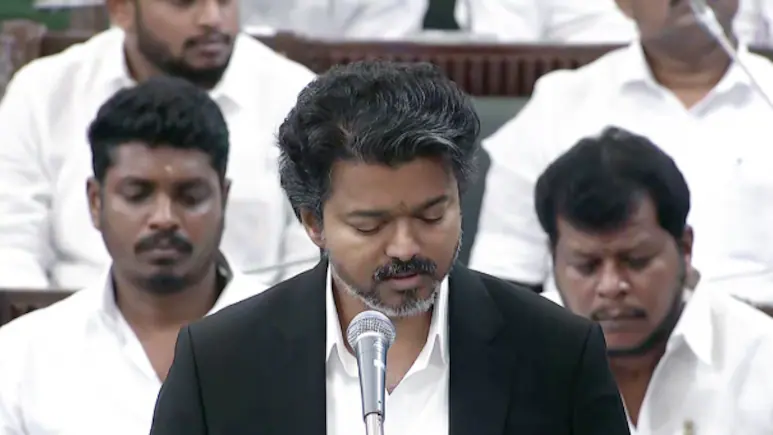
Vijay on NEET became a major talking point after the Tamil Nadu Chief Minister strongly criticized the National Eligibility cum Entrance Test (NEET) during a session of the state Assembly. Addressing lawmakers, Vijay argued that the medical entrance examination creates inequality among students and reiterated that Tamil Nadu would continue to follow its long-standing two-language policy.
The remarks come amid ongoing debates over education policy, language requirements, and the role of centralized entrance examinations in determining access to higher education. Vijay’s statement reflects Tamil Nadu’s consistent opposition to NEET and its preference for a more inclusive admissions system.
Vijay Criticizes NEET in Assembly
During the Assembly session, Vijay expressed concerns that NEET places students from different socio-economic and educational backgrounds on an uneven playing field. According to him, students from rural areas and those studying in state board schools often face greater challenges compared to candidates who have access to specialized coaching facilities.
The Chief Minister stated that education should provide equal opportunities to all students rather than creating barriers that may disadvantage certain sections of society. His comments received support from members of the ruling alliance who have repeatedly voiced concerns regarding the impact of NEET on students from underprivileged backgrounds.
The discussion once again brought the issue of medical admissions into the spotlight, with education policy becoming a key topic of debate within the Assembly.
Why Vijay Says NEET Creates Inequality
One of the primary arguments raised by Vijay is that NEET tends to favor students who can afford expensive coaching programs and additional preparation resources.
Supporters of this view argue that:
- Urban students generally have greater access to coaching institutes.
- Students from economically weaker families may face disadvantages.
- Rural students often lack access to specialized NEET preparation centers.
- State board students may encounter challenges adapting to the exam pattern.
According to critics of NEET, these factors contribute to educational inequality despite the examination’s objective of creating a standardized admission process.
However, supporters of NEET maintain that the examination promotes merit-based admissions and establishes a common standard for medical education across the country.
Tamil Nadu’s Stand on the Two-Language Policy
Apart from criticizing NEET, Vijay reaffirmed Tamil Nadu’s commitment to the two-language policy, which has been a cornerstone of the state’s educational framework for decades.
Under this approach, students typically study:
- Tamil (or their mother tongue)
- English
The policy differs from the three-language formula promoted in some parts of the country.
Vijay emphasized that Tamil Nadu’s language policy has successfully served students for many years and remains aligned with the state’s educational and cultural priorities. He stated that the government intends to continue supporting the two-language system while protecting linguistic diversity and educational accessibility.
The issue has frequently generated discussions between the state and central governments regarding curriculum and language implementation.
Political Reactions to Vijay’s Statement
Vijay’s remarks have generated significant political reactions across party lines.
Supporters welcomed his comments, arguing that he was defending the interests of students who face challenges under the current examination system. They believe the state should continue advocating for educational reforms that address regional and socio-economic disparities.
Opposition voices, meanwhile, argued that NEET helps maintain uniform standards in medical admissions and ensures transparency in the selection process. Some political leaders suggested that reforms should focus on improving educational infrastructure rather than opposing the examination itself.
The differing viewpoints highlight the complexity of the NEET debate and its broader implications for education policy in India.
NEET Debate Continues Across India
The controversy surrounding NEET has existed since the examination became the primary gateway for admission to medical colleges.
Supporters argue that NEET:
- Promotes merit-based admissions.
- Creates a uniform evaluation system.
- Reduces inconsistencies across states.
- Enhances transparency.
Critics argue that NEET:
- Encourages coaching culture.
- Places rural students at a disadvantage.
- Creates additional financial burdens on families.
- May not adequately reflect school-level performance.
The debate has led several states and political parties to seek changes in how medical admissions are conducted.
Impact on Students and Education Policy
The discussion surrounding Vijay on NEET reflects broader concerns about educational access and equality.
Students preparing for medical careers often face intense competition and pressure. Policymakers continue exploring ways to balance merit, accessibility, and fairness within the admission process.
Education experts suggest that long-term solutions may require:
- Strengthening government schools.
- Improving rural educational infrastructure.
- Expanding access to quality learning resources.
- Providing affordable preparation support for competitive examinations.
Such measures could help address concerns about inequality while maintaining academic standards.
Also read: Lucknow Commercial Building Fire: At Least 15 Dead in Massive Blaze