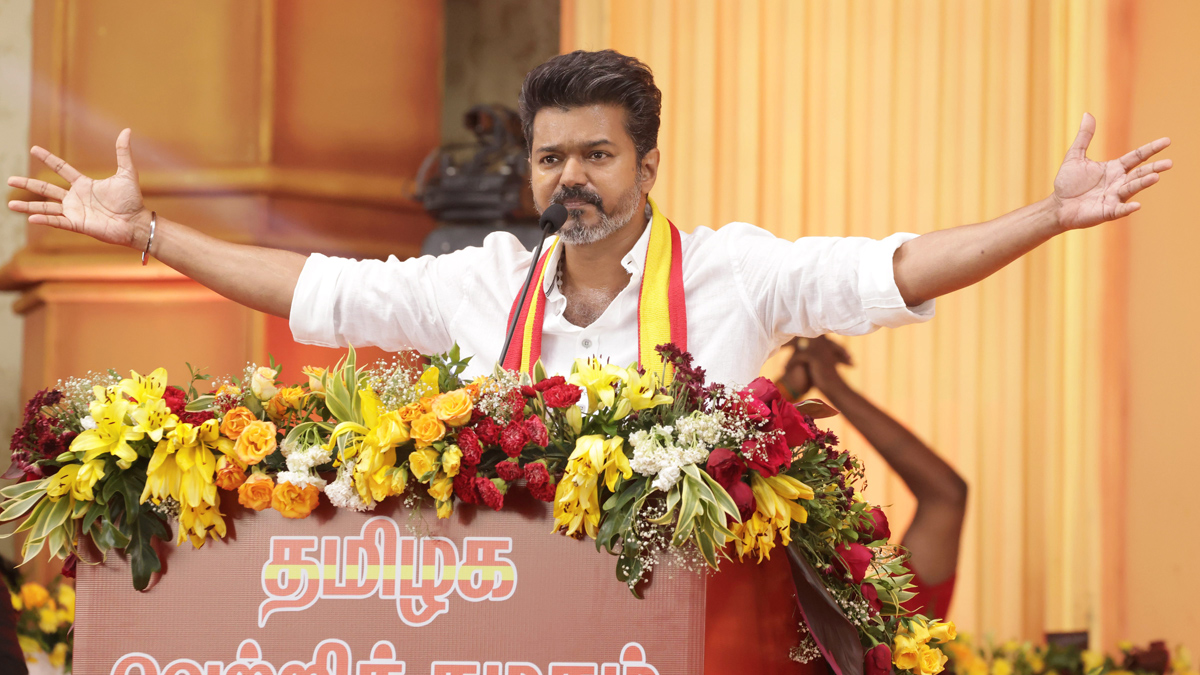
Tamil Nadu has delivered a political earthquake in the 2026 Assembly elections, with actor-turned-politician Joseph Vijay Chandrasekhar leading his party, Tamilaga Vettri Kazhagam, to emerge as the single largest force in the state. However, despite this historic debut, TVK has fallen short of the majority mark, pushing the state into a hung Assembly scenario.
According to the latest results, TVK has secured around 108–109 seats in the 234-member Assembly—just short of the 118 seats required for a clear majority. This has created a complex political situation, where the next government will depend heavily on alliances and strategic negotiations.
A Historic Debut, But Not Enough
Vijay’s entry into politics has dramatically reshaped Tamil Nadu’s traditional two-party system dominated by the Dravida Munnetra Kazhagam and the All India Anna Dravida Munnetra Kazhagam.
TVK’s performance is unprecedented for a debut party, displacing established players and capturing a significant share of voter support. Analysts say this marks the biggest political shift in the state in decades.
Yet, the lack of a full majority means Vijay cannot form the government on his own—at least not without support.
What Happens Next? Key Scenarios
With no party crossing the majority mark, Tamil Nadu is now in a classic hung Assembly situation. Here are the most likely scenarios:
1. Coalition Government (Most Likely)
TVK may seek support from smaller parties or independents to cross the majority mark. Reports suggest backchannel talks are already underway with parties like Congress and regional outfits.
If successful, Vijay could be sworn in as Chief Minister with coalition backing.
2. Alliance with Major Parties (Unlikely but Possible)
Another possibility is a post-poll alliance with either DMK or AIADMK. However, this would be politically complicated, as TVK positioned itself as an alternative to both traditional Dravidian giants during the campaign.
Still, in a hung Assembly, political pragmatism often overrides campaign rhetoric.
3. Minority Government
TVK could attempt to form a minority government, relying on outside support without formal alliances. This would allow Vijay to take power but could lead to instability, as the government would depend on continuous external backing.
4. Governor’s Rule or Fresh Elections
If no party manages to form a government within the constitutional deadline, the state could face President’s Rule followed by fresh elections. Reports indicate that TVK has limited time to prove majority support.
This remains a last-resort scenario but cannot be ruled out.
Why TVK Succeeded
Several factors contributed to TVK’s stunning rise:
- Anti-incumbency sentiment against existing parties
- Vijay’s massive fan base converting into a political vote bank
- Focus on youth, employment, and governance reforms
- Strong grassroots organization built before elections
TVK’s campaign strategy effectively tapped into voter demand for change, offering an alternative to the decades-old DMK vs AIADMK rivalry.
Challenges Ahead for Vijay
Despite the strong performance, the real challenge begins now. Vijay must transition from a political disruptor to a potential administrator.
Key challenges include:
- Securing stable support in the Assembly
- Managing coalition pressures
- Delivering on ambitious promises
- Maintaining public trust amid high expectations
Political experts believe that how Vijay handles this moment will define his long-term future in politics.
A New Era in Tamil Nadu Politics
The 2026 election marks a turning point in Tamil Nadu’s political history. For decades, the state has been dominated by Dravidian parties. The rise of TVK signals the emergence of a new political force capable of challenging the status quo.
While the final outcome remains uncertain, one thing is clear—Tamil Nadu politics has entered a new phase, with Vijay at its center.