India-Japan AI, Energy Pacts Signed After Modi-Takaichi Talks
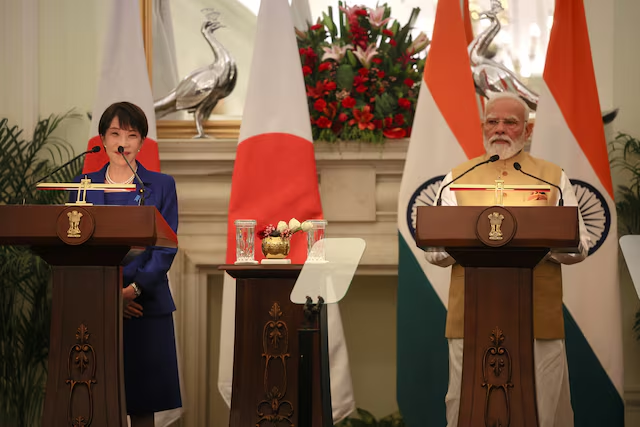
India-Japan AI, energy pacts marked a major step forward in strengthening the strategic partnership between the two Asian nations after Prime Minister Narendra Modi and Japanese Prime Minister Sanae Takaichi held high-level talks in New Delhi. The agreements cover key sectors including artificial intelligence, critical minerals, clean energy, defence cooperation and economic security, reflecting both countries’ shared vision for deeper collaboration amid an increasingly uncertain global environment.
The announcements came during the 16th India-Japan Annual Summit, where the two leaders reaffirmed their commitment to expanding trade, investment and technology partnerships. Both sides also unveiled a joint roadmap on economic security and signed multiple cooperation agreements designed to improve supply chain resilience and encourage innovation in emerging technologies.
The latest initiatives are expected to strengthen bilateral relations while supporting economic growth and technological development in both countries.
Leaders Deepen Strategic Partnership
Prime Minister Modi welcomed his Japanese counterpart to New Delhi, describing India and Japan as trusted partners with a shared commitment to peace, stability and prosperity in the Indo-Pacific region.
Following bilateral discussions, both leaders stressed the importance of working together in areas that are becoming increasingly important for global economic growth, including artificial intelligence, advanced manufacturing, clean energy and critical technologies.
Prime Minister Takaichi said the partnership between India and Japan has become even more significant amid changing global geopolitical and economic conditions, adding that both nations complement each other’s strengths.
AI Cooperation Takes Centre Stage
One of the biggest outcomes of the summit was enhanced cooperation in artificial intelligence.
The two countries agreed to deepen collaboration by combining Japan’s expertise in precision engineering and advanced manufacturing with India’s growing software capabilities and digital talent. The partnership aims to accelerate innovation, promote responsible AI development and encourage research collaborations between institutions and industries.
Officials believe that stronger AI cooperation will also create opportunities for startups, researchers and technology companies while supporting both countries’ ambitions to become leaders in next-generation technologies.
Agreements On Energy And Critical Minerals
Energy security emerged as another major focus of the summit.
India and Japan agreed to expand cooperation in clean energy initiatives and strengthen collaboration in critical minerals, which are essential for electric vehicles, batteries, semiconductors and renewable energy technologies.
The leaders also discussed measures to improve supply chain resilience, ensuring stable access to strategically important resources amid increasing global competition.
In addition, the two countries announced new initiatives to promote sustainable energy development and support future industrial growth.
Defence And Economic Security Strengthened
Beyond technology and energy, the summit also produced significant progress in defence cooperation.
India and Japan signed their first defence co-development agreement, highlighting growing security cooperation between the two Quad partners. The countries also adopted a joint roadmap on economic security to address challenges related to global supply chains, emerging technologies and strategic industries.
The leaders emphasized that closer coordination would help both nations respond more effectively to global economic disruptions while strengthening long-term strategic stability.
Trade And Investment Continue To Grow
Economic ties between India and Japan have expanded steadily in recent years.
According to official figures, bilateral trade reached approximately $27.5 billion during the 2025–26 financial year, while Japanese investment in India totalled around $3.2 billion between April and December 2025. During Prime Minister Modi’s earlier visit to Tokyo, Japan also pledged to increase long-term investment in India significantly over the coming decade.
Japanese companies continue to play a major role in India’s infrastructure development, manufacturing sector and technology ecosystem, with investments spanning transportation, finance and renewable energy.
Quad Partnership Gains Momentum
Both India and Japan reiterated their commitment to a free, open and inclusive Indo-Pacific through closer cooperation under the Quad grouping, which also includes the United States and Australia.
Officials noted that collaboration in artificial intelligence, critical technologies and supply chain resilience aligns with broader regional efforts to enhance economic security while promoting innovation.
The leaders also discussed maritime cooperation and regional stability, emphasizing the importance of maintaining a rules-based international order.
Businesses Expected To Benefit
The agreements announced during the summit are expected to create new opportunities for businesses in both countries.
Technology firms could benefit from increased AI collaboration, while companies involved in renewable energy, manufacturing and critical minerals may gain access to new partnerships and investment opportunities.
Industry experts believe the expanded cooperation will encourage joint ventures, research initiatives and greater exchange of knowledge, supporting economic growth and job creation over the coming years.
Also read: US-Iran Doha Talks Show Positive Progress, Says Qatar