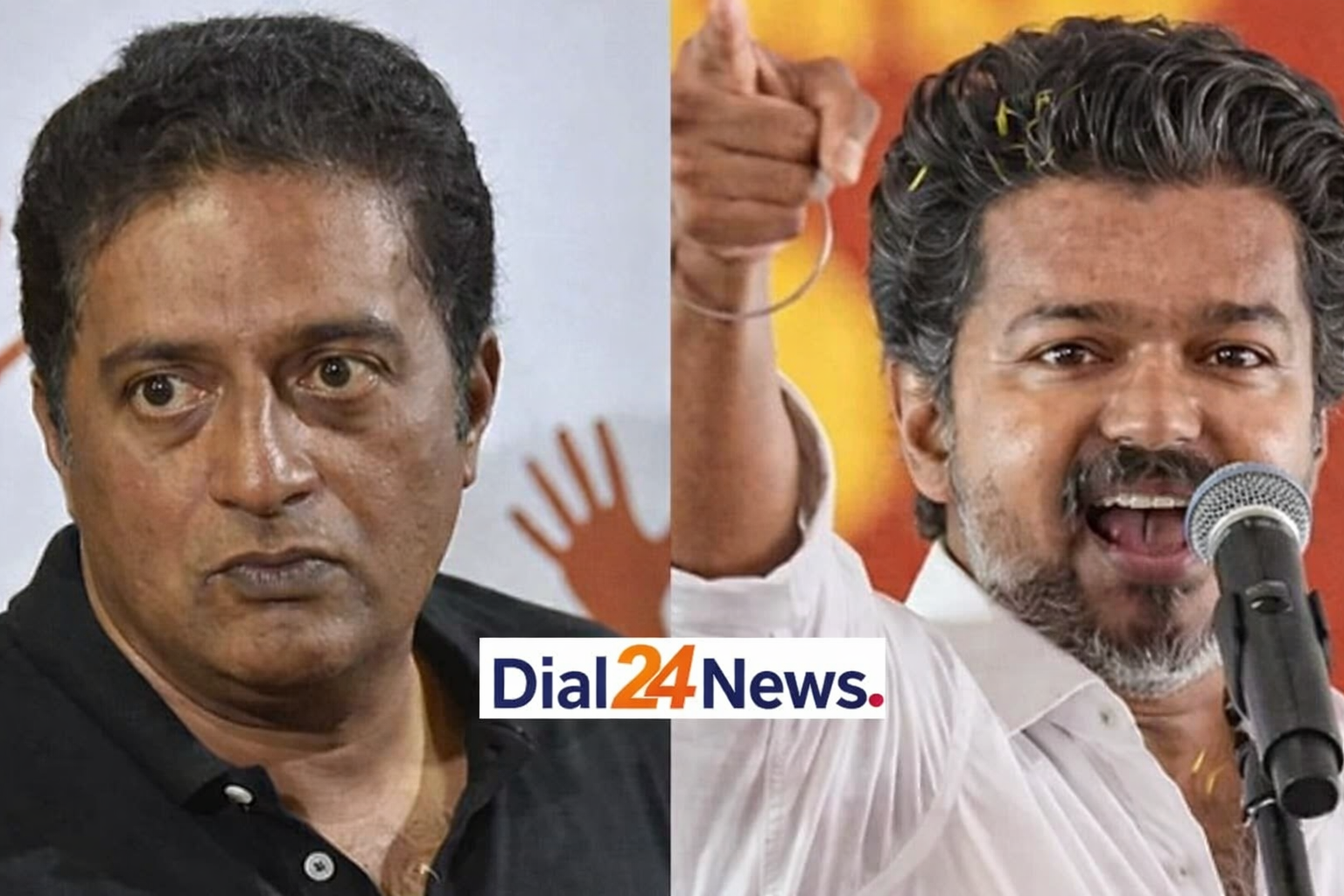
Prakash Raj Backs Vijay Amid Tamil Nadu Hung Assembly Row, Calls Governor’s Conduct ‘Unacceptable’
Actor and political commentator Prakash Raj has strongly criticised the conduct of Tamil Nadu Governor Rajendra Vishwanath Arlekar amid the ongoing government formation drama following the 2026 Tamil Nadu Assembly elections.
Reacting to the constitutional uncertainty after the hung assembly verdict, Prakash Raj termed the Governor’s approach “unacceptable” and openly supported actor-turned-politician Vijay and his party Tamilaga Vettri Kazhagam (TVK), insisting that the single largest party must be given a fair opportunity to prove its majority on the Assembly floor.
Governor Under Fire After TVK Stakes Claim
The controversy erupted after TVK emerged as the single largest party in the Tamil Nadu Assembly elections with 108 seats, falling short of the majority mark but outperforming both the DMK and AIADMK alliances.
Vijay formally met Governor Arlekar and staked claim to form the government. However, reports suggest the Governor asked TVK to produce additional letters of support before extending an invitation to form the government, triggering sharp political reactions across the state.
Prakash Raj argued that constitutional morality demands the Governor allow the largest party to attempt forming the government rather than delay the process unnecessarily. According to him, democracy should be tested on the Assembly floor and not through prolonged political uncertainty.
Prakash Raj Extends Support to Vijay
Although Prakash Raj has previously criticised mainstream political parties in Tamil Nadu, his latest remarks were seen as a significant endorsement of Vijay’s political rise.
The actor reportedly said Vijay and TVK deserved a fair democratic chance because the electorate had clearly delivered a strong mandate in favour of political change. He also questioned why there appeared to be hesitation in inviting TVK to prove majority support despite being the largest party in the Assembly.
Political observers noted that Raj’s comments carry weight because he has consistently spoken against what he describes as authoritarian or partisan actions by constitutional authorities.
Support Builds for TVK Across Tamil Nadu
The pressure on the Governor has intensified as multiple political groups, including Left parties and sections of Congress leadership, have backed TVK’s claim to form the government.
Leaders from the VCK and Left parties publicly demanded that Vijay be invited to take the floor test, accusing the Governor of delaying the democratic process.
At the same time, Congress leaders in Tamil Nadu reportedly expressed willingness to support TVK in order to prevent political instability in the state.
The evolving situation has created one of the most dramatic post-election political scenarios in recent Tamil Nadu history.
Vijay’s Political Rise Reshapes Tamil Nadu Politics
The 2026 Assembly election marked a historic breakthrough for Vijay and TVK. In its very first electoral contest, the party shattered decades of dominance by the DMK and AIADMK, emerging as the biggest political force in the state.
Analysts believe TVK’s strong performance was driven by:
- Youth and first-time voters
- Anti-incumbency sentiment
- Vijay’s massive fan base
- Social media-driven campaigning
- Promises focused on jobs and governance reform
Many political commentators are now comparing Vijay’s political entry to the rise of former Tamil cinema icons-turned-chief ministers like MGR and Jayalalithaa.
Latest Political Developments
As of now, intense behind-the-scenes negotiations continue in Chennai over government formation. Reports suggest TVK is trying to secure additional support from smaller parties and independents to comfortably cross the majority mark.
Meanwhile, the Governor’s next move remains under national scrutiny because it could determine whether:
- TVK forms the government
- Another alliance stakes claim
- President’s Rule becomes a possibility
- Fresh elections are considered
The issue has now grown beyond routine politics and evolved into a major debate over constitutional propriety and democratic convention.